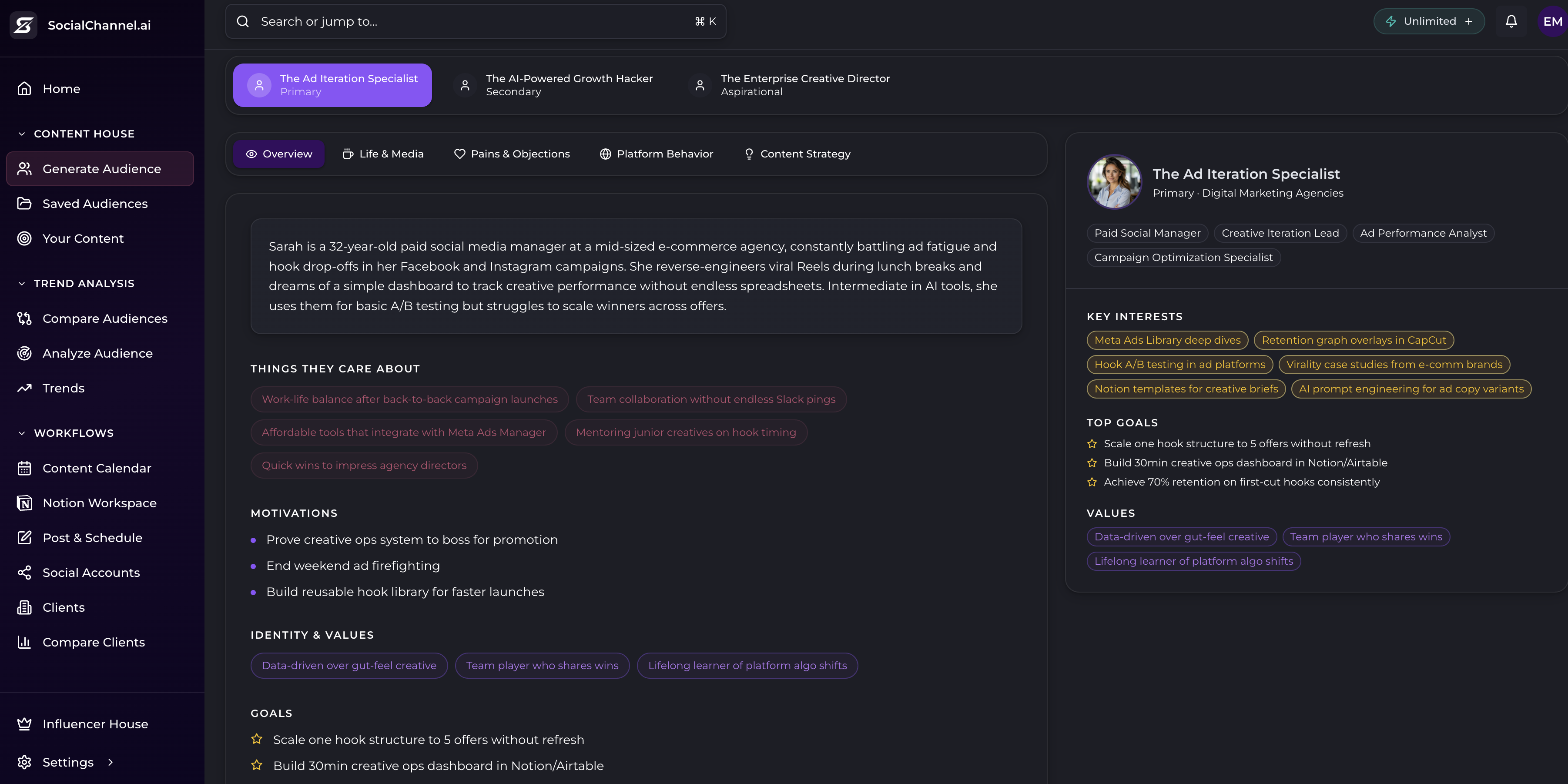
A useful TikTok audience persona has three tiers (primary, secondary, aspirational) and includes platform behaviour, slang, content triggers, pain points, and conversion patterns. You can build it manually in ~4 hours, or in 2 minutes using Socialchannel.ai's Audience Generator which automates the research.
Why Demographic Profiles Don't Work on TikTok
TikTok's algorithm doesn't optimize for demographics. It optimizes for behavioural signal — what specific people watch through, share, save, comment on. "Women 18-34" is too broad to make any content decision useful. The algorithm knows the difference between Gen Z women interested in budgeting after a layoff vs Gen Z women interested in luxury skincare. Your persona needs the same resolution.
The 3-Tier Persona Framework
A useful persona has three tiers because no creator wins talking to one segment only:
- Primary audience — the core viewer who consumes most of your content and converts when you sell
- Secondary audience — the spillover viewer who watches occasionally and amplifies your best content
- Aspirational audience — who your primary audience wants to become; powerful for positioning content that signals upward mobility
Each tier needs the same data structure: demographics, platform behaviour, slang, content triggers, pain points, and conversion patterns.
Step 1 — Identify Your Primary Audience
Start with the audience that already engages most with your content. If you have any analytics, look at the demographics of your top 5 best-performing TikToks and the comments on them. Patterns will emerge — age range, location clusters, common interests visible in commenter bios.
If you don't have analytics yet (new creator), use a proxy: search 3-5 hashtags adjacent to your niche on TikTok, scroll the For You content under each, and read the top 50 comments. The repeated themes are your primary audience.
Step 2 — Research Their Platform Behaviour
Demographics tell you who they are; platform behaviour tells you when and how they consume content. For each tier, document:
- Time of day they're most active on TikTok (correlates with posting time)
- Format preferences (POV vs talking-head vs split-screen vs B-roll narration)
- Average watch-through patterns (do they stay for 60s videos or only 15s?)
- Sound preferences (trending audio vs custom audio)
This is the data that converts a persona from a marketing exercise into a content decision tool.
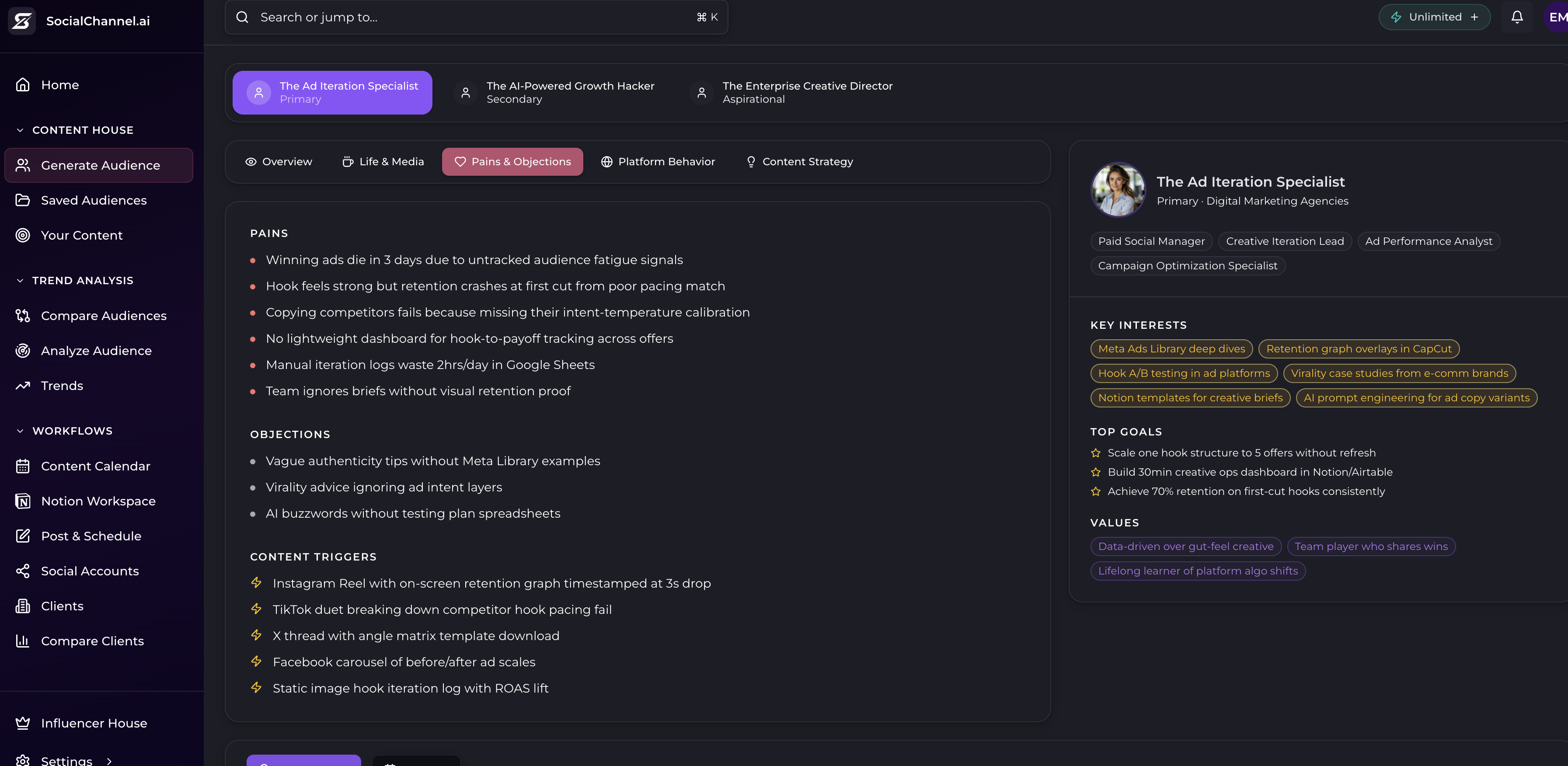
Step 3 — Capture Slang, Pain Points, Content Triggers
This is the layer most personas skip — and the layer that makes hooks land. Specifically:
- Slang — the actual phrases your audience uses. "Girl math" hits with Gen Z women in finance content; "corporate baddie" hits with mid-20s women in career content.
- Pain points — the specific frustrations or fears your audience has. Not generic "wants to lose weight" but specific "hates feeling judged at the gym."
- Content triggers — the specific topics that make this audience stop scrolling. POV, before/after, contrarian takes, niche drama, behind-the-scenes.
Step 4 — Map Conversion Patterns
If you sell anything (course, coaching, product, affiliate), document how this audience actually buys. What does the path from first TikTok view to purchase look like? How long is it? What CTAs work? What pricing they accept?
This step is what turns a content persona into a business persona. Most creators skip it.
The Manual vs AI Build
Doing the above manually is roughly 4 hours of research per tier — call it 12 hours total for a 3-tier persona. Realistic for a serious creator launching a new niche.
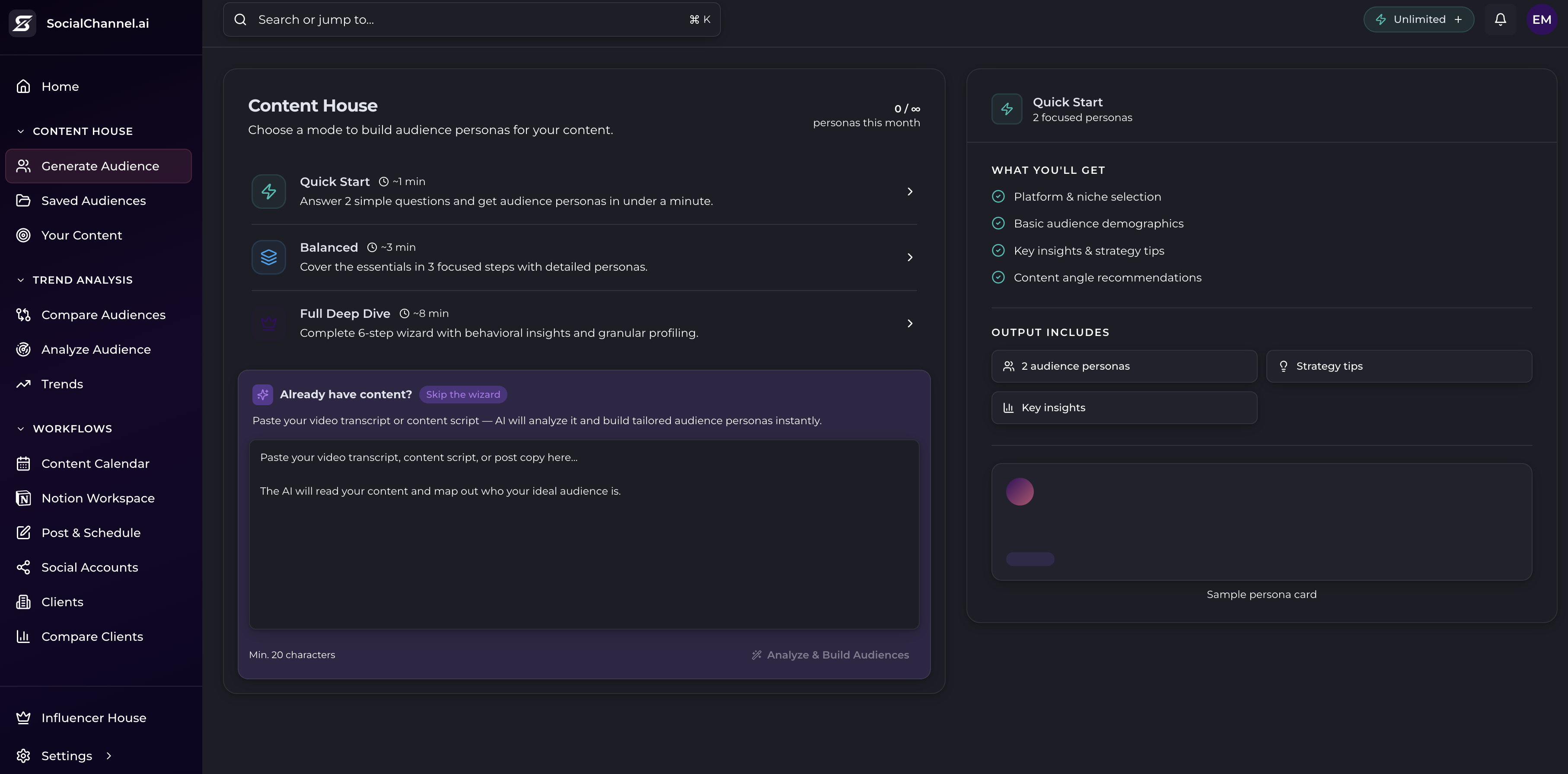
The faster path: Socialchannel.ai's Audience Generator builds the same 3-tier persona structure in 2 minutes, pulling from real platform data and AI inference. The trade-off is precision — manual research with your specific niche knowledge can produce a slightly more nuanced persona than the AI version. But the AI version takes 2 minutes and is good enough to start producing content from immediately.
What to Do With the Persona Once It's Built
The persona is only valuable if it drives content decisions. Three concrete uses:
- Hook generation — every hook should reference a pain point or content trigger from the persona
- Trend filtering — when a TikTok trend hits, ask "would the primary audience care about this?" before participating
- Content audits — review your last 10 posts against the persona; the ones that don't address a persona pain point or trigger probably underperformed
Skip the 12 hours — generate your 3-tier persona in 2 minutes
Socialchannel.ai's Audience Generator builds the full 3-tier persona structure from real platform data. Try free for 15 days.
Start Free TrialFrequently Asked Questions
How do I build an audience persona for TikTok?
Start with your primary audience (the segment that already engages most with your content), then add secondary and aspirational tiers. Each tier needs demographics, platform behaviour, slang, pain points, content triggers, and conversion patterns. The manual build takes ~12 hours; Socialchannel.ai's Audience Generator does it in 2 minutes.
What is the difference between an audience persona and a demographic profile?
Demographic profiles describe who your audience is ("women 18-34"). Personas describe how they behave on a specific platform — what slang they use, what triggers them to stop scrolling, what pain points they have, how they convert. TikTok's algorithm optimizes for behavioural signal, not demographics, so personas drive better content decisions.
Why does TikTok need a 3-tier persona?
No creator wins talking to one segment only. The 3-tier framework (primary, secondary, aspirational) captures the realistic spread of who actually consumes your content and who is influenced by it. Aspirational audiences in particular drive distribution because content positioning that appeals to who your audience wants to become tends to over-perform.
Can AI build an accurate TikTok audience persona?
Persona-aware AI tools like Socialchannel.ai's Audience Generator build accurate 3-tier personas in 2 minutes using real platform data and inference. The AI version is roughly 80-90% as nuanced as a manually-researched persona but 200-300x faster — useful for getting started immediately and iterating from there.
Related Articles
Best Social Media Tool for TikTok Creators in 2026
What to do with the persona once you've built it.
Audience StrategyHow to Build a Niche Audience Persona with AI (in 2 Minutes)
The 2-minute version of this 12-hour manual build.
TikTok StrategyBest AI Tool for Faceless TikTok Channels in 2026
Persona-driven scripts for faceless TikTok.
AI ComparisonChatGPT vs Socialchannel.ai for Social Media Content (2026)
Why generic AI plateaus without persona context.